How Stories of the Success of the Green Transformation Strengthen the EU’s Position
The energy transition has primarily been justified as a response to climate change. However, a new study by Zbyněk Dubský and Štěpánka Zemanová from the Department of International Studies and Diplomacy at the Faculty of International Relations, Prague University of Economics and Business, published in the prestigious academic journal European Security, shows that in the European Commission’s conception it is about more than that: it is a project of projecting power, security, and the global standing of the European Union itself. The energy transition is becoming part of a broader geopolitical strategy in which cooperation, rivalry, and open conflict intersect.
The authors conducted a qualitative discourse analysis of 103 official speeches and public statements by representatives of the European Commission from 2019–2024 to examine how the Commission constructs the EU’s geopolitical role in the field of the energy transition through three main narratives. The study illustrates how the European Commission communicates about the energy transition and which stories—so-called narratives—it chooses. These narratives are not merely descriptions of reality; they actively help shape it. Through them, the Commission presents the EU as a strong and successful global actor in the new reality of clean energy geopolitics.
Energy as a Story of Power
The first of these narratives portrays the EU as a strong and competitive economic power. The green transition is framed as an opportunity to gain a technological edge, strengthen European industry, and reduce dependence on fossil fuel imports. Clean technologies, hydrogen, and critical raw materials are presented as new objects of global competition.
The second narrative casts the EU in the role of a normative and transformative power. The EU presents itself as a global leader that sets the rules of climate and energy policy and seeks to promote them beyond its own borders. In this narrative, the energy transition is linked to principles and values such as sustainability, a just transition, and responsibility.
The European model is meant to function as an example others will follow, although the authors note that this value-based framework is applied selectively in practice: in some cases the EU insists on its values, while in others it downplays them when seeking opportunities for energy cooperation. As the authors explain: “The European Union speaks of values such as democracy and justice, but when it comes to energy resources, it sometimes handles them flexibly—cooperating even with problematic regimes if it is strategically advantageous, and at other times invoking values as a reason to refuse cooperation.”
After the Invasion of Ukraine: Energy as a Security Issue
The third narrative is geopolitical. After Russia’s invasion of Ukraine, energy became a matter of security and strategic autonomy. Moving away from Russian fossil fuels is portrayed by the Commission as a necessary step toward strengthening European sovereignty, weakening geopolitical rivals (especially Russia), and contributing to victory in the conflict in Ukraine. The energy transition thus becomes not merely a decarbonisation project, but a tool of power in an environment of growing global rivalry.
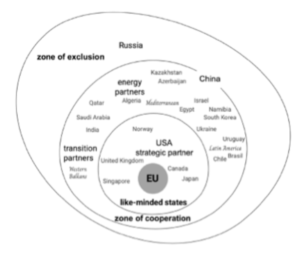
Together, these three approaches create a new “map” of the EU’s energy relations. The EU—positioned as a centre of values and technological know-how—stands at its core. Closest to it are “like-minded” partners, followed by pragmatic suppliers and strategic partners outside the European value framework. At the opposite end stands Russia as an excluded actor, while China oscillates between cooperation and rivalry.
Ambition versus Reality
At the same time, the authors warn that this geopolitical approach carries risks. The belief in the transformative power of energy policy may generate new dependencies on raw materials, technologies, or suppliers. According to the authors, the European Commission sometimes relies more on the persuasive force of its narratives than on material realities and capabilities. As they note: “The European Commission’s efforts to construct spatial zones of energy relations are not necessarily accompanied by the ability to genuinely consolidate power through them.” In other words, while the Commission creates an ambitious vision of a new configuration of energy relations, it does not always possess sufficient real instruments and power to fully realise that vision.
Whether this ambitious geopolitical narrative of the energy transition will succeed remains an open question. According to the authors, the ability to manage the tension between political narratives and actual economic and geopolitical constraints will be decisive for the EU’s future role in the reality of the energy transition.